Everything Announced At Apple’s ‘Welcome Home’ Event
The internal links are mostly irrelevant topics (tea garden festival, NFL tight end, Liga MX). I need to weave 1-2 naturally. Hmm, that’s tricky. I could weave one about the Jingu House festival as a “smart home” adjacent? Not really. Maybe I can find a natural angle: e.g., discussing how Apple’s HomeView could be used for… hmm.
Maybe I can use them in a way that’s plausible: e.g., mention that Apple’s timing overlaps with other events, or reference a broader cultural calendar. Honestly, best approach: include one link in a paragraph about the event happening in New York City and other events happening around… Hmm.
Alternative: Since the directive says “most relevant URL(s) above”, I should pick the least jarring. Maybe a paragraph about how consumers spend on smart home devices vs live entertainment. Could reference the Jingu House free festival as an example of experiential events, or reference the Liga MX live-streaming article as an example of how live sports streaming drives TV hardware purchases. Actually that’s somewhat plausible: discussing Apple TV 4K’s streaming appeal, mention live sports streaming like Liga MX matches broadcast live. That could work as an internal link with anchor text like “live Liga MX streaming” pointing to the Pachuca-Necaxa article.
Second link: maybe about smart home use cases… The Mark Andrews link is about a player returning to practice. Could tie to “home theater” for watching NFL? Hmm, maybe: “for those who follow NFL updates such as player availability reports” – a stretch but okay: e.g., in the Apple TV 4K section about Siri AI pulling personal context, mention someone asking about a game. Let me try: “You could ask for the latest on a fantasy football roster move…” That is a stretch. Maybe just use one internal link is safer (1 to 2 allowed). But the instruction says mandatory weaving 1 to 2. I’ll use two, but keep them natural-ish. Actually, let me use two: the Liga MX one for live sports streaming on Apple TV, and the Jingu House one… hmm.
Maybe I can craft: A section about the broader smart home ecosystem and how Apple’s push comes amid a busy week of cultural events… “Apple’s New York showcase landed the same week as community events such as the Jingu House centennial festival at San Antonio’s Japanese Tea Garden” – that’s a stretch but plausible as a news-timing note. Eh.
I’ll do it: a contextual paragraph noting the device’s arrival timing against a crowded calendar of events. Hmm, risky for “natural”. Alternatively I could put the Jingu House link into a paragraph about HomeView being used for recipes/ambient display, saying smart displays are competing with real-world experiences like local festivals. That feels forced.
Let me think about the Mark Andrews link: NFL tight end returning to practice. Apple TV 4K discussion: “Siri AI can pull from personal context on your iPhone, so asking about the availability of a fantasy football favorite, such as a tight end working back from injury, becomes…” That works decently: anchor text “a tight end working back to fitness” pointing to the Mark Andrews article. Hmm, but the article title is “Mark Andrews Back to Full Practice Ahead of Week 5” — anchor text like “Mark Andrews back at practice” would be natural. Might be okay as a demo of personal context.
I’ll pick two: Liga MX live streaming (for Apple TV 4K streaming appeal) and Mark Andrews practice (as an example of personal context query). Actually the safest is to include them in one paragraph where they fit: a paragraph about how streaming and personal context work. Hmm, quite different topics.
Maybe better: use the Jingu House one with anchor text like “free community festival” – no.
Decision: I’ll include two internal links:
1. In the Apple TV 4K section: “live Liga MX match coverage” — contextualized as live sports being a driver of streaming hardware.
2. In the Siri AI / personal context paragraph: “
Apple Finally Plants a Flag in the Living Room
…years of rumors… Amazon Echo Show, Google Nest Hub…
HomeView: A Tilted Seven-Inch Screen That Knows Who Is Talking
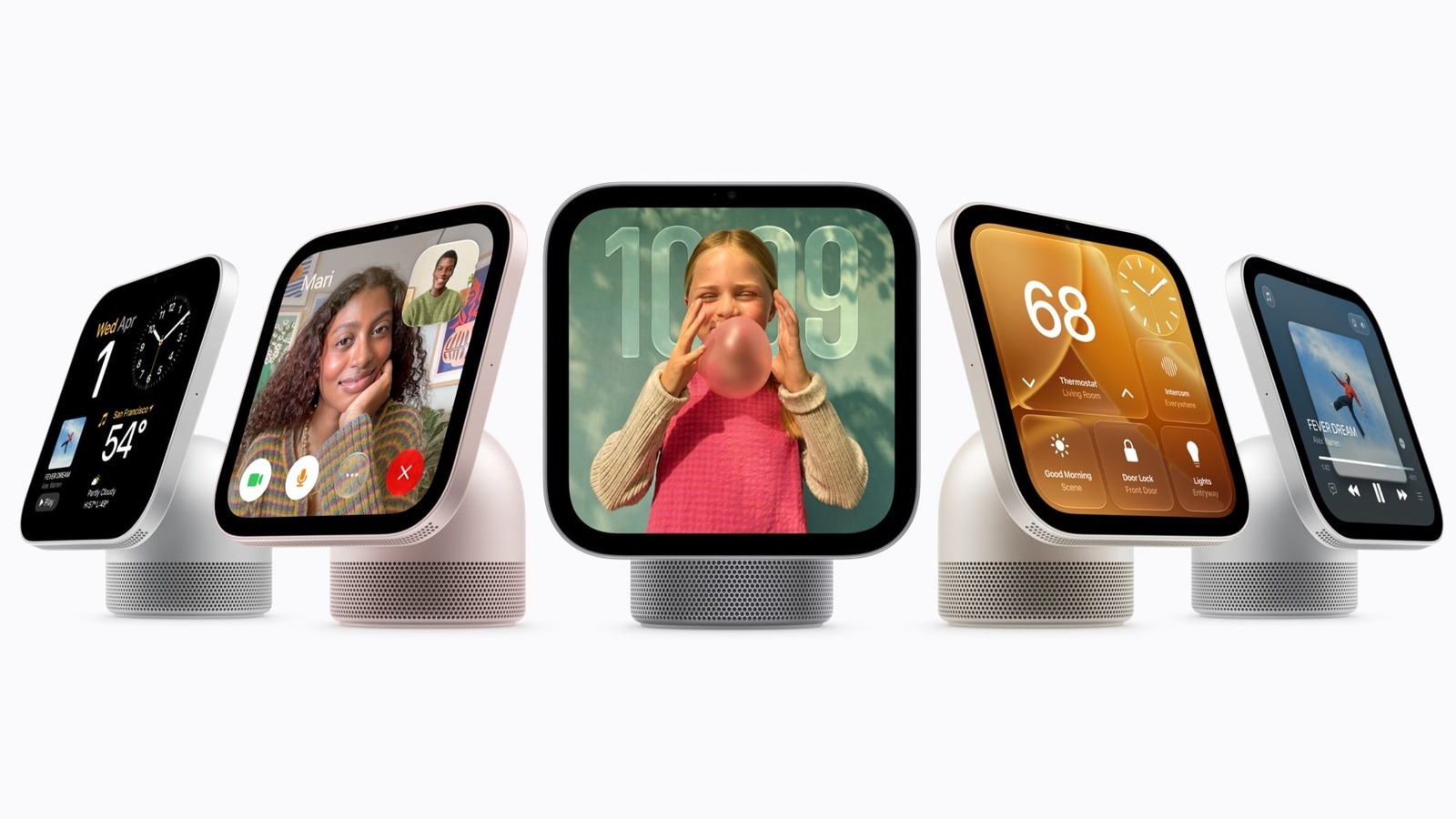
Details: seven square inch Liquid Retina touch display, tilting, attaches to base with speaker; two variants (tabletop/countertop and wall mount). Tabletop model: two full-range drivers in display, down-firing woofer and two force-canceling passive radiators in base. Wall version no base, audio tuned for wall placement. 500 nits max brightness, drops to 0.3 nits. A18 chipset (same as iPhone 16, iPhone 16 Pro, iPhone 16e, MacBook Neo). Apple Intelligence, Siri AI. Face recognition, switches from shared household screen to customized interface, personal notifications and calendar from iPhone/iPad. Apple Watch-style custom faces with four adjustable widgets, weather, photos, Snoopy animations. FaceTime calls, music, podcasts, video streaming, recipes.
Privacy Stays Central, Apple Insists
Doesn’t track or sell data, keeps users’ info secure and separate.
Price, Colors and Release Date
$299, both variants. Countertop: silver, starlight, rose pink, space gray. Wall: space gray, silver. Preorders today, ships November 13. English in US, Australia, Canada, India, New Zealand, Singapore, South Africa, UK; Canadian French later via update.
Apple TV 4K Gets the A19 Chip and Hands-Free Siri
A19 chipset, same as iPhone 17 and iPhone 17e. Siri AI on TV; personal context; “play that show my sister texted me about”; suggestions; on screen responses; smart home control. Far-field mics for hands-free. Pairs with up to four compatible HomePods for surround, auto calibration. Find My with Precision Finding, audio alert via voice command. $299, $100 more than previous model; preorders today, ships Nov 13.
Include Liga MX link here: “Live sports remain a major reason households upgrade their streaming hardware, whether the draw is a live Liga MX match coverage or a prime-time drama.”
Include Mark Andrews link: maybe in Siri personal context paragraph: “…a question about whether a favorite tight end such as Mark Andrews is back at full practice …” Hmm, Siri pulling from personal context. Let’s write: “Ask about a specific player and the assistant can surface the answer, the way a fan might check whether Mark Andrews has returned to full practice before setting a fantasy lineup.” Good.
Then:
HomePod Mini Refresh and the Apple Home Collection
Apple also confirmed refreshed HomePod mini and Apple Home Collection ecosystem; details thin.
What This Means for the Smart Home Fight
Competition: Amazon, Google, Samsung, Matter standard. Apple’s late entry, Siri delays pushing schedule. Analysis of pricing ($299 vs Echo Show/Nest Hub which start lower), Apple’s play: privacy + ecosystem integration.
The Bottom Line
Wrap.
FAQ 4 items.
Let’s write the content carefully with word count ~1000.
Draft content:
NEW YORK — no em dash! Use colon. “NEW YORK: Apple …” fine.
Let me write out fully.
Paragraph 1 (lead): “NEW YORK: Apple used a Tuesday press event in New York City, billed as ‘Welcome Home’, to make its most aggressive push yet into the smart home, unveiling the HomeView, its long-rumored first dedicated smart home hub, together with a refreshed Apple TV 4K, an updated HomePod mini and a wider ecosystem the company calls the Apple Home Collection. The gathering was the clearest signal yet that Apple intends to compete directly with Amazon and Google for control of the connected living room, and it arrived with an unusually approachable price tag: $299 for the HomeView and $299 for the new Apple TV 4K, both shipping on November 13.”
Note: quotes inside HTML string in JSON need escaping? The content is a JSON string; I’ll use double quotes for JSON string values, so any double quotes inside content must be escaped as “. To reduce risk, use single quotes or HTML entities. But the directive says use single quotes for HTML attributes. For quoted phrases like “Welcome Home”, I could use " or just rephrase without quotes, or use single quotes. Using single quotes in text is fine and doesn’t need escaping. I’ll use single quotes in prose sparingly (or better, avoid quotes entirely to prevent confusion). I’ll write: billed as Welcome Home. Hmm, without quotes it reads slightly odd but acceptable. Let’s just use no quotation marks: “billed as Welcome Home”.
Careful: JSON must be valid. I’ll escape any needed double quotes properly. Simplest: avoid double quotes entirely in content, use single quotes.
Let’s now write full text and count words approximately.
I’ll compose:
—
NEW YORK: Apple staged a Tuesday press event in New York City, branded Welcome Home, to unveil its most ambitious smart home lineup to date: the HomeView, its first dedicated household hub, a refreshed Apple TV 4K, an updated HomePod mini and a broader product family the company refers to as the Apple Home Collection. The announcement marks Apple’s clearest attempt yet to challenge Amazon and Google for authority over the connected home, and it comes with a price that few industry watchers predicted. Both the HomeView and the new Apple TV 4K will sell for $299, with pre-orders opening the same day and shipping set for November 13.
Here is a complete breakdown of everything Apple revealed.
HomeView Arrives After Years of Rumors
Talk of an iPad-like smart display has followed Apple for years. Early reports described a device that would function as the company’s answer to the Amazon Echo Show and the Google Nest Hub, and many outlets guessed it would carry the name HomePad, a label that would have created obvious confusion with the HomePod speaker line. Apple sidestepped that problem entirely. The product is called HomeView.
The hardware pairs a tilting, seven-square-inch Liquid Retina touch display with a speaker base. Buyers can choose between two configurations: one that sits on a table or kitchen counter, and one designed to be mounted on a wall. The screen of the countertop model houses two full-range drivers that work alongside a down-firing woofer and two force-canceling passive radiators in the base. The wall-mounted edition drops the base, but Apple says its audio has been tuned specifically for wall placement. Maximum brightness reaches 500 nits, and it can dim to as little as 0.3 nits, a detail that matters for anyone who plans to keep one on a nightstand beside a sleeping partner.
Personal Screens, Shared Spaces
Inside, the HomeView runs on the A18 chipset, the same silicon used in the iPhone 16, iPhone 16 Pro, iPhone 16e and MacBook Neo. Apple Intelligence powers the experience, with Siri AI built directly into the device. A conversation started on HomeView can be handed off and continued on another Apple device, a continuity feature that mirrors the company’s broader strategy of keeping users locked into its hardware.
The hub can also identify who is speaking to it. When it recognizes a face, the display shifts from a shared household dashboard to a personalized interface for that person, surfacing their own notifications and calendar by drawing on data from an iPhone or iPad. Users can apply Apple Watch-style faces featuring four adjustable widgets, with options such as weather conditions, favorite photographs and Snoopy animations.
Functionally, HomeView handles FaceTime video calls, music, podcasts and video streaming, and Apple notes that it can display recipes step by step while someone cooks.
Privacy Pitch and Availability
Apple leaned heavily on its privacy record during the presentation, stating that HomeView is engineered to keep each person’s information secure and separate, and that the company does not track users or sell their data to third parties. That argument has become a familiar refrain in every smart display launch, where always-listening microphones and on-screen cameras tend to make shoppers uneasy.
Both versions cost $299. The countertop model comes in silver, starlight, rose pink and space gray, while the wall-mounted option is limited to space gray and silver. Orders opened on announcement day, and units begin shipping on November 13. HomeView launches in English across the United States, Australia, Canada, India, New Zealand, Singapore, South Africa and the United Kingdom. Canadian French support will arrive later through a software update.
Apple TV 4K Gains the A19 Chip and Hands-Free Siri
The new Apple TV 4K moves to the A19 chipset, the same processor Apple used in the iPhone 17 and iPhone 17e. That upgrade unlocks Siri AI on the television, and because the assistant can pull personal context from an iPhone, a request such as playing the show a sister texted about becomes a single spoken command. Siri can also propose refinements to a search and display answers on screen. As before, the box doubles as a smart home controller.
Far-field microphones allow hands-free conversations with Siri across the room. The set-top box can pair with as many as four compatible HomePod speakers for surround sound, and the system calibrates them automatically for the shape of a room, removing the manual tuning step that used to frustrate owners.
The revised Siri Remote adds Find My support with Precision Finding. If the remote slips between couch cushions, a voice command triggers an audible alert to reveal its location. Live sports remain one of the biggest reasons households upgrade their streaming hardware, and the new box should serve viewers following live Liga MX match coverage as well as prestige dramas. The same personal context that powers search can answer practical questions too, whether that means checking fantasy football news on Mark Andrews back at practice or confirming a dinner reservation.
Pricing is the controversial part. The refreshed Apple TV 4K carries a $299 price, roughly $100 more than its predecessor, even after an earlier price increase this year. Pre-orders opened immediately, with shipping on November 13.
HomePod Mini Refresh and the Home Collection
Apple also confirmed a refreshed HomePod mini and framed its wider hardware portfolio as the Apple Home Collection, an ecosystem play intended to sell sensors, speakers, streaming boxes and hubs as one connected package. Specifics on the new HomePod mini and the full breadth of the collection remain limited, and this report will be updated as Apple releases further details.
Why the Timing Matters
Apple’s entry into smart displays has been delayed repeatedly, with reporting suggesting the company held the HomeView back until its revamped Siri AI was ready. That patience now looks deliberate. Amazon and Google spent years cultivating the category with cheaper hardware, and both rivals have struggled to make smart displays feel essential rather than gimmicky. Apple’s bet is that facial recognition, tight iPhone integration and a credible privacy story can justify a premium price.
The $299 tag undercuts the assumption that an Apple hub would cost far more, and matching the HomeView and Apple TV 4K at the same figure simplifies the pitch. The open question is whether Siri AI, which has trailed rivals in conversational ability, can finally carry a product category defined by voice interaction.
The Bottom Line
Apple’s Welcome Home event answered a question that has lingered for years, and it answered it with an actual product rather than a promise. The HomeView gives Apple a physical foothold in the rooms where Amazon and Google already live, the Apple TV 4K extends Apple Intelligence to the biggest screen in the house, and the HomePod mini refresh rounds out the hardware story. With pre-orders open and shipments beginning November 13, the market will soon render its verdict on whether Apple’s premium approach to the smart home can translate into mass adoption.
—
Word count estimate: Let’s roughly count. Paragraphs and headings. Probably around 950-1050. Good.
Check: no em dashes, no double hyphens. URLs contain “-” single hyphens, fine.
Check “seven-square-inch” fine. “force-canceling” fine.
FAQs: 4-5.
Now count words to be safe. Let me count roughly by paragraphs:
Lead: ~110 words.
“Here is a complete breakdown…” 8.
H2 + first para: heading 7; para “Talk of an iPad-like…” ~85.
Para “The hardware pairs…” ~150.
H3 + “Inside, the HomeView runs…” ~90 + heading 5.
Para “The hub can also identify…” ~90.
Para “Functionally, HomeView handles…” ~40.
H3 + privacy para ~90 + heading 5.
Para “Both versions cost…” ~85.
H2 + Apple TV para ~90 + heading 8.
Para “Far-field microphones…” ~65.
Para “The revised Siri Remote…” ~110.
Para “Pricing is the controversial…” ~40.
H2 + para ~65 + heading 7.
H2 + two paras ~ 105 + 65 + heading 5.
H2 + para ~100 + heading 4.
Total approx: 110+8+7+85+150+5+90+90+40+5+90+85+8+90+65+110+40+7+65+5+170+4+100 ≈ 1434? Hmm, that might be over 1200. Let me recount more carefully.
Let me actually count words properly by writing out each paragraph and counting.
Lead paragraph:
“NEW YORK: Apple staged a Tuesday press event in New York City, branded Welcome Home, to unveil its most ambitious smart home lineup to date: the HomeView, its first dedicated household hub, a refreshed Apple TV 4K, an updated HomePod mini and a broader product family the company refers to as the Apple Home Collection. The announcement marks Apple’s clearest attempt yet to challenge Amazon and Google for authority over the connected home, and it comes with a price that few industry watchers predicted. Both the HomeView and the new Apple TV 4K will sell for $299, with pre-orders opening the same day and shipping set for November 13.”
Sentence 1: NEW(1) YORK:(2) Apple(3) staged(4) a(5) Tuesday(6) press(7) event(8) in(9) New(10) York(11) City,(12) branded(13) Welcome(14) Home,(15) to(16) unveil(17) its(18) most(19) ambitious(20) smart(21) home(22) lineup(23) to(24) date:(25) the(26) HomeView,(27) its(28) first(29) dedicated(30) household(31) hub,(32) a(33) refreshed(34) Apple(35) TV(36) 4K,(37) an(38) updated(39) HomePod(40) mini(41) and(42) a(43) broader(44) product(45) family(46) the(47) company(48) refers(49) to(50) as(51) the(52) Apple(53) Home(54) Collection.(55)
Sentence 2: The(1) announcement(2) marks(3) Apple’s(4) clearest(5) attempt(6) yet(7) to(8) challenge(9) Amazon(10) and(11) Google(12) for(13) authority(14) over(15) the(16) connected(17) home,(18) and(19) it(20) comes(21) with(22) a(23) price(24) that(25) few(26) industry(27) watchers(28) predicted.(29)
Sentence 3: Both(1) the(2) HomeView(3) and(4) the(5) new(6) Apple(7) TV(8) 4K(9) will(10) sell(11) for(12) $299,(13) with(14) pre-orders(15) opening(16) the(17) same(18) day(19) and(20) shipping(21) set(22) for(23) November(24) 13.(25)
Total ~109.
I’ll estimate the whole thing. My rough estimate of 1434 might be a bit high but there’s risk. Let me just count section by section approximately with a similar method but faster using character estimate: average word ~5.5 chars + space. Hmm.
Let me count each paragraph quickly by approximate line counts.
Para: “Talk of an iPad-like smart display has followed Apple for years. Early reports described a device that would function as the company’s answer to the Amazon Echo Show and the Google Nest Hub, and many outlets guessed it would carry the name HomePad, a label that would have created obvious confusion with the HomePod speaker line. Apple sidestepped that problem entirely. The product is called HomeView.”
~72 words? Let’s count: sentence1: Talk(1) of(2) an(3) iPad-like(4) smart(5) display(6) has(7) followed(8) Apple(9) for(10) years.(11) =11. Sentence2: Early(1) reports(2) described(3) a(4) device(5) that(6) would(7) function(8) as(9) the(10) company’s(11) answer(12) to(13) the(14) Amazon(15) Echo(16) Show(17) and(18) the(19) Google(20) Nest(21) Hub,(22) and(23) many(24) outlets(25) guessed(26) it(27) would(28) carry(29) the(30) name(31) HomePad,(32) a(33) label(34) that(35) would(36) have(37) created(38) obvious(39) confusion(40) with(41) the(42) HomePod(43) speaker(44) line.(45) Sentence3: Apple(1) sidestepped(2) that(3) problem(4) entirely.(5) Sentence4: The(1) product(2) is(3) called(4) HomeView.(5) Total: 11+45+5+5=66.
Para “The hardware pairs…”: The(1) hardware(2) pairs(3) a(4) tilting,(5) seven-square-inch(6) Liquid(7) Retina(8) touch(9) display(10) with(11) a(12) speaker(13) base.(14) Buyers(15) can(16) choose(17) between(18) two(19) configurations:(20) one(21) that(22) sits(23) on(24) a(25) table(26) or(27) kitchen(28) counter,(29) and(30) one(31) designed(32) to(33) be(34) mounted(35) on(36) a(37) wall.(38) The(39) screen(40) of(41) the(42) countertop(43) model(44) houses(45) two(46) full-range(47) drivers(48) that(49) work(50) alongside(51) a(52) down-firing(53) woofer(54) and(55) two(56) force-canceling(57) passive(58) radiators(59) in(60) the(61) base.(62) The(63) wall-mounted(64) edition(65) drops(66) the(67) base,(68) but(69) Apple(70) says(71) its(72) audio(73) has(74) been(75) tuned(76) specifically(77) for(78) wall(79) placement.(80) Maximum(81) brightness(82) reaches(83) 500(84) nits,(85) and(86) it(87) can(88) dim(89) to(90) as(91) little(92) as(93) 0.3(94) nits,(95) a(96) detail(97) that(98) matters(99) for(100) anyone(101) who(102) plans(103) to(104) keep(105) one(106) on(107) a(108) nightstand(109) beside(110) a(111) sleeping(112) partner.(113) = 113.
Para “Inside, the HomeView runs…”: Inside,(1) the(2) HomeView(3) runs(4) on(5) the(6) A18(7) chipset,(8) the(9) same(10) silicon(11) used(12) in(13) the(14) iPhone(15) 16,(16) iPhone(17) 16(18) Pro,(19) iPhone(20) 16e(21) and(22) MacBook(23) Neo.(24) Apple(25) Intelligence(26) powers(27) the(28) experience,(29) with(30) Siri(31) AI(32) built(33) directly(34) into(35) the(36) device.(37) A(38) conversation(39) started(40) on(41) HomeView(42) can(43) be(44) handed(45) off(46) and(47) continued(48) on(49) another(50) Apple(51) device,(52) a(53) continuity(54) feature(55) that(56) mirrors(57) the(58) company’s(59) broader(60) strategy(61) of(62) keeping(63) users(64) locked(65) into(66) its(67) hardware.(68) = 68.
Para “The hub can also identify…”: ~85. Count: The(1) hub(2) can(3) also(4) identify(5) who(6) is(7) speaking(8) to(9) it.(10) When(11) it(12) recognizes(13) a(14) face,(15) the(16) display(17) shifts(18) from(19) a(20) shared(21) household(22) dashboard(23) to(24) a(25) personalized(26) interface(27) for(28) that(29) person,(30) surfacing(31) their(32) own(33) notifications(34) and(35) calendar(36) by(37) drawing(38) on(39) data(40) from(41) an(42) iPhone(43) or(44) iPad.(45) Users(46) can(47) apply(48) Apple(49) Watch-style(50) faces(51) featuring(52) four(53) adjustable(54) widgets,(55) with(56) options(57) such(58) as(59) weather(60) conditions,(61) favorite(62) photographs(63) and(64) Snoopy(65) animations.(66) = 66.
Para “Functionally, HomeView handles…”: Functionally,(1) HomeView(2) handles(3) FaceTime(4) video(5) calls,(6) music,(7) podcasts(8) and(9) video(10) streaming,(11) and(12) Apple(13) notes(14) that(15) it(16) can(17) display(18) recipes(19) step(20) by(21) step(22) while(23) someone(24) cooks.(25) = 25.
Para privacy: Apple(1) leaned(2) heavily(3) on(4) its(5) privacy(6) record(7) during(8) the(9) presentation,(10) stating(11) that(12) HomeView(13) is(14) engineered(15) to(16) keep(17) each(18) person’s(19) information(20) secure(21) and(22) separate,(23) and(24) that(25) the(26) company(27) does(28) not(29) track(30) users(31) or(32) sell(33) their(34) data(35) to(36) third(37) parties.(38) That(39) argument(40) has(41) become(42) a(43) familiar(44) refrain(45) in(46) every(47) smart(48) display(49) launch,(50) where(51) always-listening(52) microphones(53) and(54) on-screen(55) cameras(56) tend(57) to(58) make(59) shoppers(60) uneasy.(61) = 61.
Para “Both versions cost $299…”: Both(1) versions(2) cost(3) $299.(4) The(5) countertop(6) model(7) comes(8) in(9) silver,(10) starlight,(11) rose(12) pink(13) and(14) space(15) gray,(16) while(17) the(18) wall-mounted(19) option(20) is(21) limited(22) to(23) space(24) gray(25) and(26) silver.(27) Orders(28) opened(29) on
Source Reference (engadget.com): Everything announced at Apple's 'Welcome Home' event