Inside the Market for 9317 123rd St in South Richmond Hill
Queens home shoppers who attempted to pull up the property record for 9317 123rd St in South Richmond Hill, New York, recently came away with a blank wall instead of a floor plan. The page that should have displayed photographs, square footage and an asking price gave way to a terse technical notice: ‘This is taking longer than usual.’ Alongside that failure, the site served up a string of characters, d4dd0655-9e69-43e4-b9c2-74c920f0d003, labeled as a Request_ID, plus an apology and an instruction to email unblockrequest@realtor.com if the problem continued.
The glitch itself is mundane in an era when property searches are stitched together from servers, caching layers and third-party data feeds. What it obscures is far more interesting. That address sits on a narrow, well-kept block in the 11419 ZIP code, a densely built stretch of central Queens where multi-generational households, Indo-Caribbean commerce and a stubborn shortage of listings have combined to create one of the borough’s most competitive small-home markets.
A Block Defined by Queens Logic
The address format carries information on its own. In Queens, hyphenated house numbers read as coordinates rather than a single figure. The 93 in 93-17 refers to the cross-street grid, and the 17 identifies the specific lot along that grid line. Practically speaking, 9317 123rd St places the property on 123rd Street, a north-south block running between Jamaica Avenue to the north and Atlantic Avenue to the south.
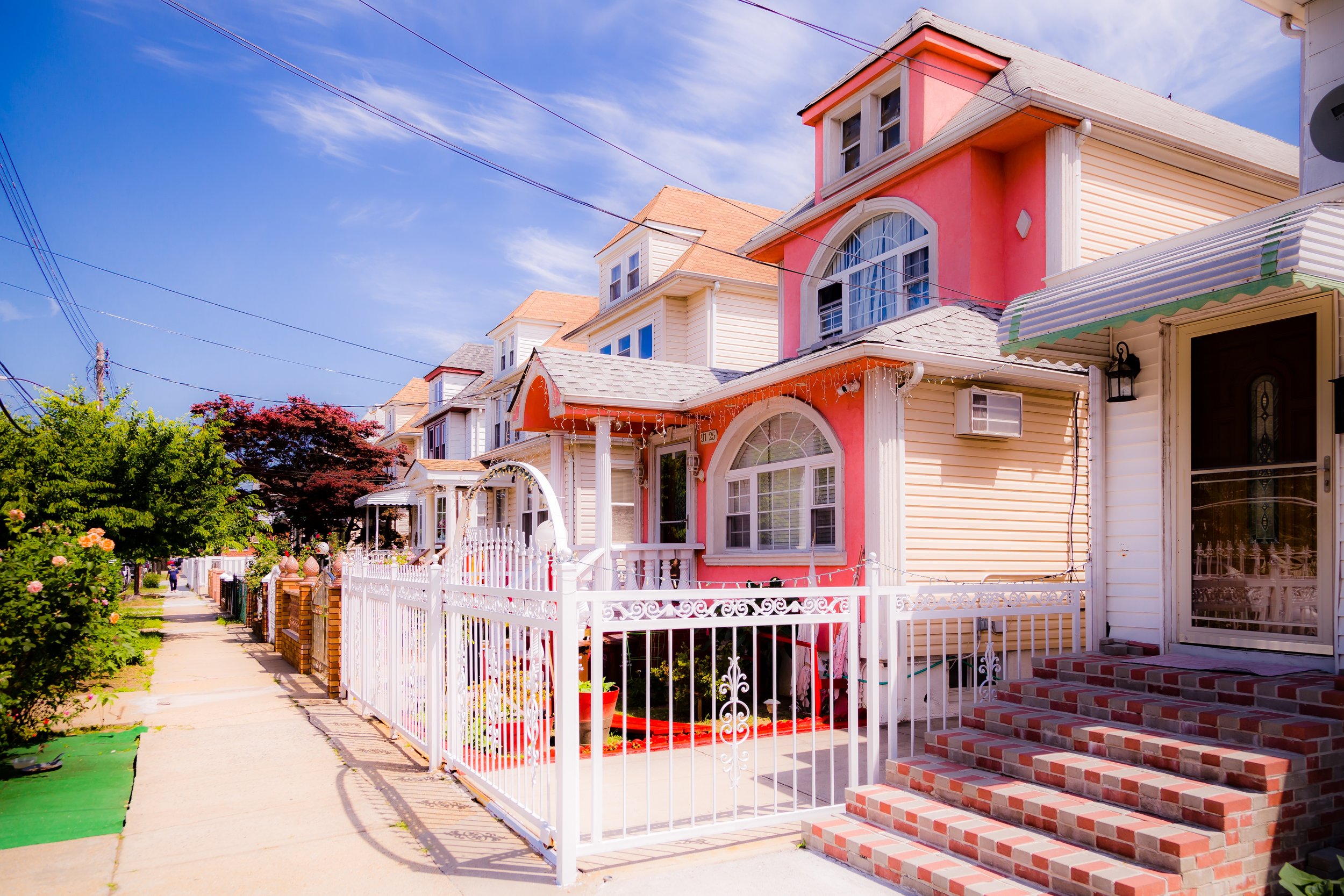
Homes along this corridor follow a familiar rhythm. Most were built in the early to mid-twentieth century as detached or semi-attached two-story structures with brick or stucco facades, compact front yards and private driveways. Over the decades, many were enlarged or legally converted into two-family and three-family dwellings, with finished basements and separate entrances that let extended families share a single mortgage. That configuration is a central reason inventory here turns over so slowly.
Recreation is close at hand. Phil ‘Scooter’ Rizzuto Park, still known to longtime residents as Smokey Oval, occupies the corner of Atlantic Avenue and 125th Street, a short walk from this block. Its ball fields fill on summer evenings with cricket and softball leagues that draw spectators from across the neighborhood.
Little Guyana and the Pull of Liberty Avenue
South Richmond Hill anchors the district widely known as Little Guyana. Liberty Avenue, a few blocks west, functions as the neighborhood’s commercial spine, lined with roti shops, sari and jewelry retailers, West Indian groceries, immigration attorneys and money transfer offices. The area’s Indo-Caribbean roots, drawn largely from Guyana and Trinidad and Tobago, surface each spring when Phagwah celebrations fill the avenue with colored powder, and again in the fall during Diwali lighting displays.
Faith institutions sit shoulder to shoulder. Mosques, mandirs, Caribbean-style churches and storefront congregations share the same few blocks, a reflection of a community that has absorbed waves of arrivals over more than four decades. More recent transplants from Bangladesh, Nepal and Latin America have added another layer to the local fabric. For prospective buyers, that diversity translates into demand that rarely hinges on a single employer or industry, a stabilizing force when the wider economy wobbles.
Transit Math That Favors Commuters
Transportation is a major part of the neighborhood’s appeal. The J and Z subway lines stop at 121st Street on Jamaica Avenue, roughly a short walk from 123rd Street. To the west, the A train’s Lefferts Boulevard and 111th Street stations sit within about a mile along Liberty Avenue. Several local bus routes trace Liberty and Jamaica avenues, feeding riders into the subway network. Drivers enjoy quick access to the Van Wyck Expressway and the Belt Parkway, and John F. Kennedy International Airport lies a short ride to the south.
That airport proximity matters more than it might appear. A significant share of residents work in aviation, hospitality, health care and the building trades, and a commute measured in minutes rather than transfers helps explain why families tend to stay put for decades.
When a Listing Page Fails to Load
The error encountered on this address deserves a little context. Real estate portals assemble pages in real time, pulling records from multiple listing services, county databases and internal systems. When one handoff in that chain stalls, the visitor sees a timeout rather than a carefully designed page. The Request_ID attached to the failure is simply a diagnostic tag that support teams can use to trace the transaction, and the quoted email address is a routing channel for visitors whose access has been blocked.
For buyers, the practical takeaway is straightforward. A loading failure says nothing about whether a home is available, correctly priced or still listed. Cross-checking the county clerk’s records, consulting a licensed agent and calling the listing brokerage directly will always yield better information than refreshing a broken browser tab.
What the Wider Market Suggests
Median sale prices in the 11419 ZIP code have generally tracked in the high six figures in recent years, with the fiercest competition reserved for homes that generate legal rental income. Cash offers are common, and bidding above the asking price is not unusual when a well-maintained two-family property reaches the market. Mortgage rates remain the single largest swing factor, shaping both what sellers expect and what buyers can carry.
National headlines have competed for attention too, including the projected path of Tropical Storm Rachel’s track toward Southern California and the summer-like warmth that swept southeastern Wisconsin, two weather stories that shaped moving decisions far from Queens.
Still, local fundamentals dominate here. School catchment areas, the age of a roof, the legal status of a basement apartment and the length of a driveway weigh far more heavily than distant weather chatter when a buyer signs a contract in central Queens.
What to Watch Next
Several factors will shape the next few months on blocks like this one. Inventory remains the headline: fewer than a handful of comparable homes typically list in the immediate area during any given season, which keeps upward pressure on prices even when mortgage rates tick higher. Renovation activity along Atlantic Avenue and Jamaica Avenue continues to modernize the retail corridor, and any easing of borrowing costs would likely release a wave of deferred demand from renters who have been priced out of nearby Forest Hills and Kew Gardens.
For anyone tracking 9317 123rd St specifically, the sensible next step is to verify the property’s status through public records and a local agent rather than relying on a single portal. The page may have timed out, but the block it points to has been quietly, stubbornly appreciating for years.
Source Reference (realtor.com): 9317 123rd St, South Richmond Hill, NY 11419
Frequently Asked Questions (FAQ)
Where exactly is 9317 123rd St located?
The property sits on 123rd Street in South Richmond Hill, Queens, New York, in the 11419 ZIP code, on a block running between Jamaica Avenue to the north and Atlantic Avenue to the south. Queens house numbers are hyphenated grid coordinates, so 93-17 identifies the cross-street grid and the specific lot position along it.
Why did the online listing page fail to load?
The page returned a timeout message reading 'This is taking longer than usual,' along with a Request_ID (d4dd0655-9e69-43e4-b9c2-74c920f0d003) and instructions to contact unblockrequest@realtor.com. Such failures typically stem from a stalled data handoff between the portal and its listing or public records sources, and they do not indicate anything about the property's availability or price.
What kind of homes are typical on this block?
The surrounding blocks are dominated by early to mid-twentieth century detached and semi-attached two-story houses with brick or stucco exteriors, compact front yards and driveways. Many have been converted into legal two-family or three-family dwellings with finished basements, which is a major reason turnover in the area is slow.
Which subway lines serve South Richmond Hill?
The J and Z lines stop at 121st Street on Jamaica Avenue, a short walk from 123rd Street. The A train serves the Lefferts Boulevard and 111th Street stations along Liberty Avenue, roughly a mile west, and several local bus routes run along Liberty and Jamaica avenues.
Is South Richmond Hill the same as Richmond Hill?
They are adjacent but distinct sections of central Queens. South Richmond Hill sits south of Jamaica Avenue and is closely associated with the Little Guyana commercial district along Liberty Avenue, while Richmond Hill proper extends north and east with its own historic district and housing stock.