MOAB: US Drops ‘Mother of All Bombs’ on Afghanistan
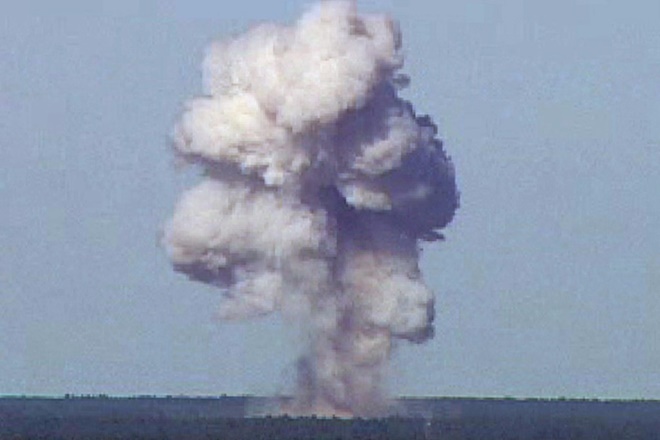
The United States military confirmed on 13 April 2017 that it had released a GBU-43/B Massive Ordnance Air Blast bomb over Nangarhar province in eastern Afghanistan, the first combat employment of the most powerful conventional weapon in the American inventory. The munition, known everywhere by its nickname, the mother of all bombs, had existed for more than a decade as a tested but unblooded piece of hardware. Its detonation over a mountainous stretch of Afghan territory turned a laboratory curiosity into a global headline within minutes.
White House press secretary Sean Spicer told reporters that the weapon had been directed at a “system of tunnels and caves” used by ISIS fighters, describing a target complex that conventional strikes had struggled to neutralize. The confirmation ended years of speculation about whether the bomb would ever leave its storage racks.
What the GBU-43/B actually is
The GBU-43/B, formally the Massive Ordnance Air Blast, weighs 21,600 pounds, or roughly 9,797 kilograms, and is a GPS-guided munition. It is not a nuclear device, and it does not depend on penetrating armour or solid rock to accomplish its task. Its destructive capacity comes from the sheer volume of explosive it carries and the pressure wave that spreads outward across a wide footprint, which is precisely why planners reach for it when the objective is not a single bunker but an entire landscape of trenches, tunnels, cave mouths, or canyon walls.
The weapon was developed by the Air Force Research Laboratory under Albert L. Weimorts, an engineer whose team was tasked with producing a bomb that could be carried by aircraft already in service rather than requiring a purpose-built bomber. Public accounts have consistently described it as the most destructive non-nuclear weapon ever devised by the United States.
How it reaches its target
The MOAB is engineered for delivery from a C-130 Hercules, most commonly the MC-130E Combat Talon I or the MC-130H Combat Talon II variants operated by Air Force Special Operations Command. The aircraft release the weapon from the rear ramp, and after a parachute-assisted stabilization sequence, GPS guidance steers it toward a designated point on the ground. That delivery method explains both the bomb’s scale and its constraints: it requires aircrew flying a large, relatively slow aircraft into a sufficiently permissive environment, and its accuracy rests on satellite signals rather than on a seeker capable of tracking a moving target.
Tested twice, never dropped in anger
Before April 2017, the GBU-43/B had only ever been detonated in testing. Its first full-scale trial took place on 11 March 2003 at Range 70, located at Eglin Air Force Base in Florida. A second test followed on 21 November 2003. Both events were photographed and publicized, part of a deliberate effort to signal capability as much as to verify engineering. The footage of a grey cylinder tumbling from a cargo ramp and then producing a towering column of dust became one of the defining images of American military messaging in that period.
Fifteen bombs and the Iraq War
According to widely cited public records, the only known production run of the MOAB amounted to 15 units, manufactured at the McAlester Army Ammunition Plant in 2003 to support the United States during the Iraq War. None of those weapons were ever released over Iraqi soil. Their purpose in that era was largely psychological: the mere existence of a bomb of that magnitude was intended to shape the calculations of Iraqi commanders and conscripts before a single unit was ever expended.
The Daisy Cutter lineage
That thinking drew directly on the BLU-82 Daisy Cutter, a weapon used heavily during the Vietnam War and again during the American-led invasion of Iraq. The Daisy Cutter was valued less for the physical destruction it produced than for the shock it delivered, and the MOAB was conceived in part to continue that intimidation on a larger scale, with more precise guidance and a far heavier charge. The lineage matters because it explains the weapon’s design philosophy: this was never a precision instrument for removing a single room from a building. It was a blunt instrument for reshaping the behaviour of people who could hear it coming.
The GBU-43/B by the numbers
- It weighs 21,600 pounds (9,797 kilograms) and is a GPS-guided munition, first tested in March 2003.
- Its official designation, GBU-43/B, sits alongside the nickname Massive Ordnance Air Blast Bomb, from which the acronym MOAB is drawn.
- It is commonly referred to as the mother of all bombs.
- It is the most powerful non-nuclear bomb in the American arsenal.
- It was dropped by an MC-130 aircraft operated by Air Force Special Operations Command.
- It had never before been used on a battlefield.
The strike in Nangarhar
Nangarhar province lies along Afghanistan’s eastern border with Pakistan, a region of steep valleys and extensive cave networks that had long offered cover to insurgent factions, including the Islamic State’s Afghan affiliate. Bombing a tunnel complex with smaller munitions tends to seal entrances without collapsing the interior, leaving fighters able to move between chambers and regroup once the dust settles. A weapon that generates an enormous overpressure effect across a broad area offers a different kind of answer, although it does not guarantee the destruction of passages buried deep beneath rock.
The Pentagon, according to reports from the period, had not designed the MOAB as a penetrator. It was intended instead for medium targets spread across huge areas, or for environments that could not be breached by conventional means, such as caves or positions tucked inside a canyon. In practical terms, the operation functioned like a five-run first inning: an attempt to overwhelm an entrenched opponent with one emphatic burst rather than through a long sequence of smaller engagements.
Why the choice of aircraft mattered
The MC-130 variants that carried the weapon belong to a small, specialized fleet built for low-level infiltration, aerial refuelling, and clandestine resupply. Using one of them for a strike of this size reflected both the technical demands of the bomb, which can only be dropped from a rear cargo ramp, and the operational reality that a larger conventional bomber cannot perform the same task. The moonless timing, the terrain, and the size of the pressure wave all shaped how the mission was flown and what the crew could expect once the weapon left the ramp.
Russia’s rival claim
The MOAB has never held the title of the world’s largest conventional bomb without dispute. Some reports indicate that Russia tested a separate weapon that Moscow claimed was four times as powerful as the American design, a device that Russian officials promoted with comparable theatricality. The competition between the two systems became a contest of messaging as much as engineering, with each side using blast footage and superlatives to project strength. The American bomb retained the more memorable nickname, largely because the phrase entered common usage first.
What the strike settled, and what it did not
The operation answered one question definitively: after fourteen years in storage, the GBU-43/B had finally been used in combat. It left many others open. A single strike cannot clear an entire province of fighters, and the tunnel networks that motivated the attack had been dug over years. Military planners acknowledged that multiple smaller strikes using lower-yield ordnance from aircraft such as the F-16 could deliver comparable effects over time, albeit with different trade-offs in speed, risk, and scale. The C-130 and the C-17 can carry far heavier loads, but neither offers the flexibility of a fighter dropping precision munitions on short notice.
The response also illustrated how governments act when a threat is judged severe enough to justify extraordinary measures. The decision to expend a one-of-a-kind asset in a single night, without an obvious follow-up strike ready to go, carried the same instinct that leads authorities to stand down a public gathering when intelligence points to danger, as when a concert is canceled over security threat at short notice. In both cases, the calculation weighs the cost of acting against the cost of waiting.
For the Pentagon, the bomb’s debut also raised questions about what comes next. Fifteen units were built to support a war that ended without them being used. Whether the remaining stock is replenished, retired, or preserved as a deterrent that is spoken about but never again deployed is a decision that belongs to a future administration, and to a future battlefield that may look nothing like the caves of Nangarhar.
Source Reference (financialexpress.com): What is the GBU-43 bomb, nicknamed the ‘mother of all bombs’, that US dropped on Afghanistan?
Frequently Asked Questions (FAQ)
What is the GBU-43/B MOAB?
The GBU-43/B Massive Ordnance Air Blast is a 21,600-pound (9,797 kilogram) GPS-guided, non-nuclear munition developed by the Air Force Research Laboratory under Albert L. Weimorts. It is the most powerful conventional bomb in the United States arsenal and is commonly called the mother of all bombs.
When was the MOAB first used in combat?
It was first used on a battlefield on 13 April 2017, when it was dropped over Nangarhar province in Afghanistan. Before that, it had only been tested, with full-scale trials on 11 March 2003 and 21 November 2003 at Eglin Air Force Base.
How many MOABs were ever built?
Public records indicate that the only known production run was 15 units, manufactured at the McAlester Army Ammunition Plant in 2003 to support the United States during the Iraq War. None of those units were used in Iraq.
What aircraft carries the GBU-43/B?
The bomb is designed for delivery from a C-130 Hercules, most often the MC-130E Combat Talon I or MC-130H Combat Talon II variants. The MC-130 that released it over Afghanistan was operated by Air Force Special Operations Command.
Why is the GBU-43/B called the mother of all bombs?
The nickname reflects the weapon's status as the largest and most destructive non-nuclear bomb in the American inventory, a device whose blast and pressure wave affect a very wide area rather than a single point target.
{“@context”:”https://schema.org”,”@type”:”FAQPage”,”mainEntity”:[{“@type”:”Question”,”name”:”What is the GBU-43/B MOAB?”,”acceptedAnswer”:{“@type”:”Answer”,”text”:”The GBU-43/B Massive Ordnance Air Blast is a 21,600-pound (9,797 kilogram) GPS-guided, non-nuclear munition developed by the Air Force Research Laboratory under Albert L. Weimorts. It is the most powerful conventional bomb in the United States arsenal and is commonly called the mother of all bombs.”}},{“@type”:”Question”,”name”:”When was the MOAB first used in combat?”,”acceptedAnswer”:{“@type”:”Answer”,”text”:”It was first used on a battlefield on 13 April 2017, when it was dropped over Nangarhar province in Afghanistan. Before that, it had only been tested, with full-scale trials on 11 March 2003 and 21 November 2003 at Eglin Air Force Base.”}},{“@type”:”Question”,”name”:”How many MOABs were ever built?”,”acceptedAnswer”:{“@type”:”Answer”,”text”:”Public records indicate that the only known production run was 15 units, manufactured at the McAlester Army Ammunition Plant in 2003 to support the United States during the Iraq War. None of those units were used in Iraq.”}},{“@type”:”Question”,”name”:”What aircraft carries the GBU-43/B?”,”acceptedAnswer”:{“@type”:”Answer”,”text”:”The bomb is designed for delivery from a C-130 Hercules, most often the MC-130E Combat Talon I or MC-130H Combat Talon II variants. The MC-130 that released it over Afghanistan was operated by Air Force Special Operations Command.”}},{“@type”:”Question”,”name”:”Why is the GBU-43/B called the mother of all bombs?”,”acceptedAnswer”:{“@type”:”Answer”,”text”:”The nickname reflects the weapon’s status as the largest and most destructive non-nuclear bomb in the American inventory, a device whose blast and pressure wave affect a very wide area rather than a single point target.”}}]}